Why Does Traverse City Have So Many Vineyards?
The lake-effect answer to why Traverse City grows wine grapes at the 45th parallel: two federally recognized AVAs, glacial soil, and a bay that moderates the climate.
Why Does Traverse City Have So Many Vineyards?
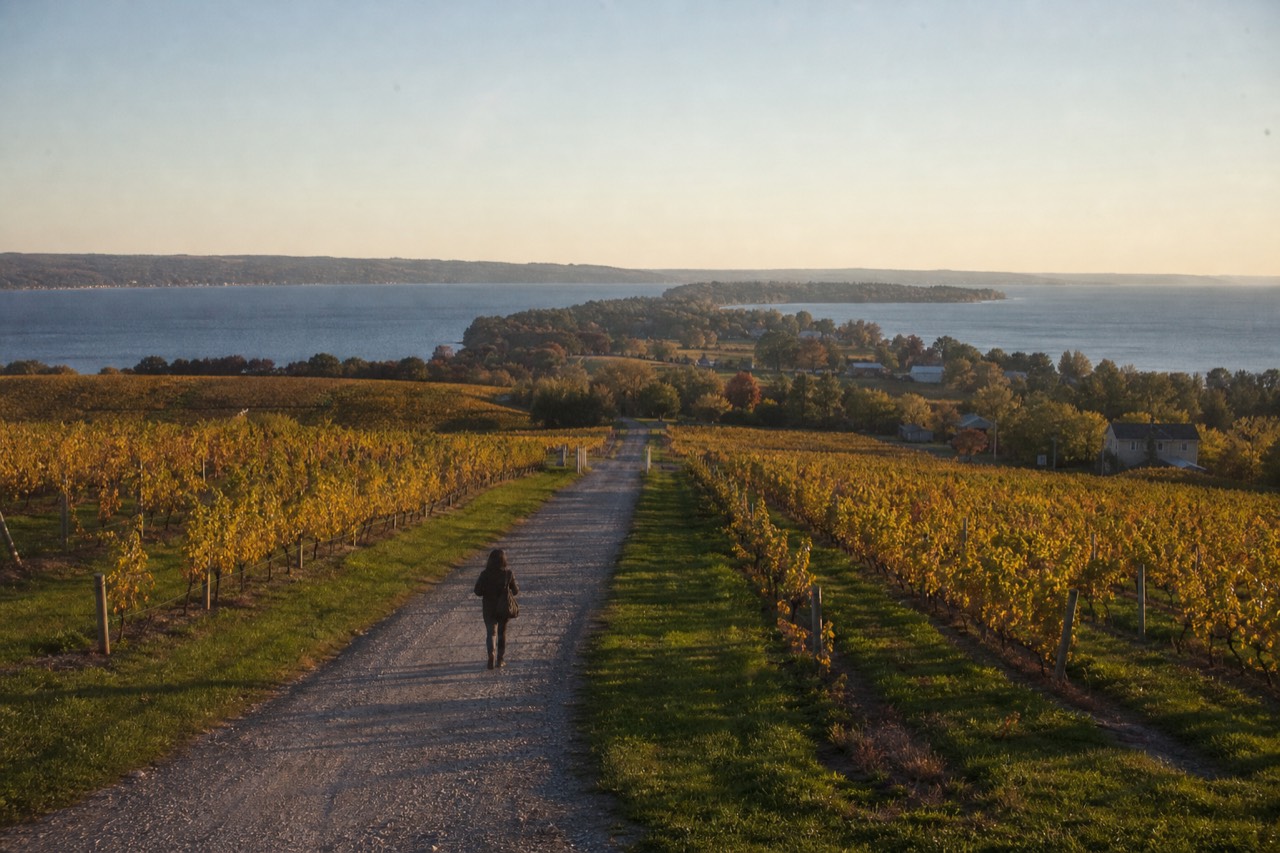
Traverse City has so many vineyards because its geography does the work most northern regions cannot: it sits on the 45th parallel, the same latitude band as parts of Bordeaux and Piedmont, and Grand Traverse Bay wraps around two narrow peninsulas so that vineyard land is never far from water. The lake effect extends the growing season, glacial soils drain well, and the federal government recognized the result with two AVAs, in 1982 and 1987.
The short version people usually give is "lake effect," and that is true, but it is only half the mechanism. Water holds heat far longer than land. In spring, cold water slows the vines from waking too early and losing their buds to a late frost. In autumn, the still-warm water holds off the first killing frost, sometimes by weeks compared with inland Michigan at the same latitude. A grape that would struggle 30 miles inland can ripen here.
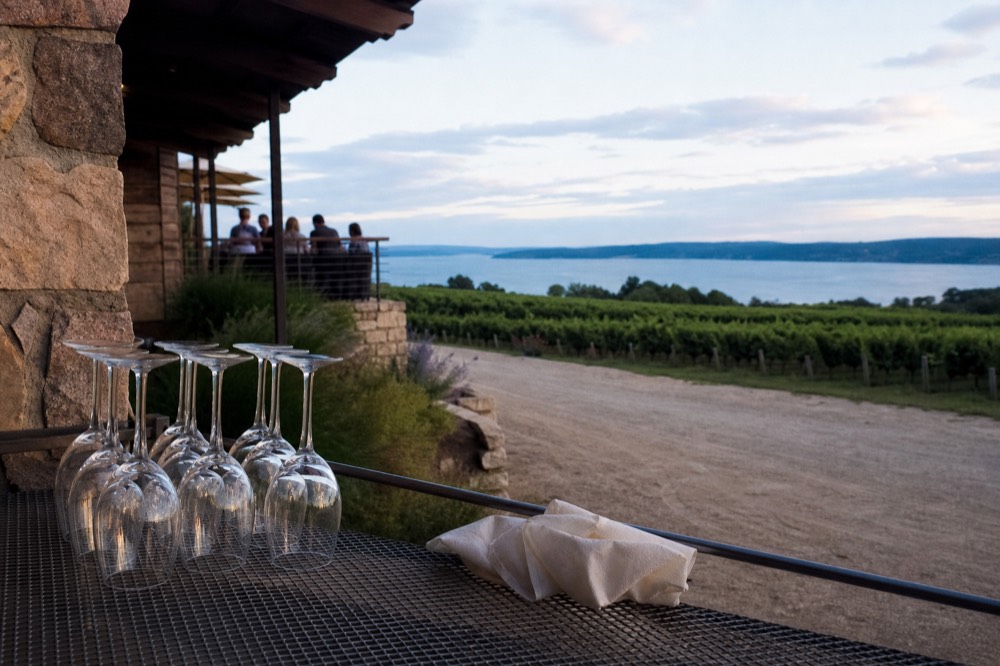
The second half is the shape of the land itself. Old Mission Peninsula is no more than three miles wide at any point and runs roughly 19 miles north from Traverse City, so a vineyard anywhere on it is close to water on both sides. Leelanau Peninsula, larger and older as a wine region, is bounded by Lake Michigan on one side and the bay on the other. Traverse City Tourism's own description of what it brands the Traverse Wine Coast puts it plainly: the moderating effect of Lake Michigan extends the growing season and allows grape ripeness across an array of wine styles, and the two peninsulas together produce over 60 percent of Michigan's grapes.
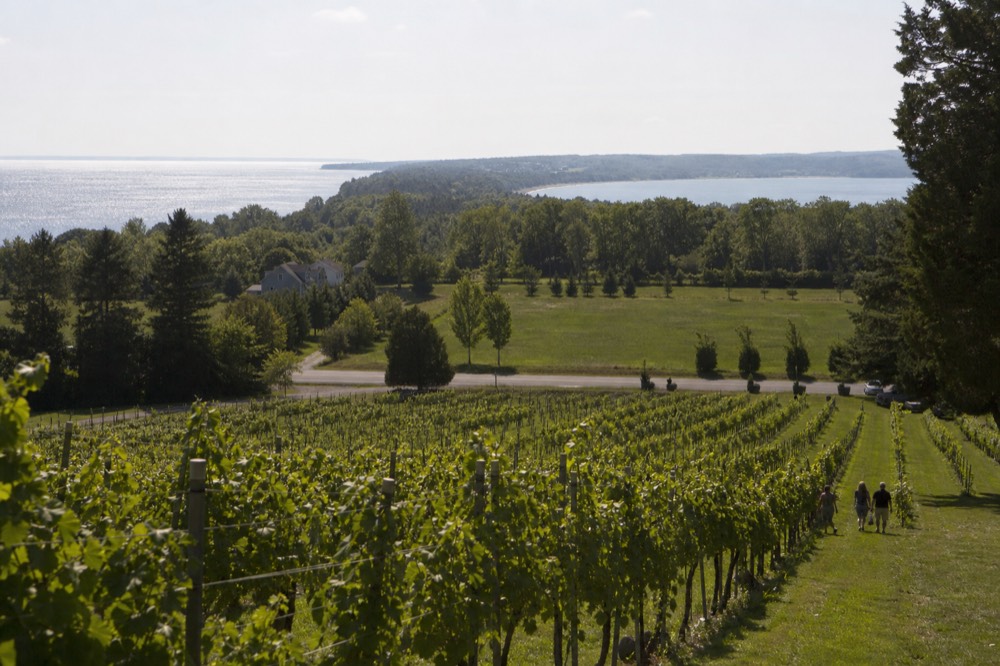
Then there is the soil. The glaciers that carved these peninsulas left behind well-drained sandy and gravelly soils, exactly what grapevines want when the alternative in a cool climate is wet clay roots. Vines that stress slightly in dry, free-draining ground put their energy into fruit rather than leaves. Between the water-moderated air and the glacial dirt, the two peninsulas offer a cool-climate wine region that works, which is rarer than it sounds at this latitude.
If you want to see the geography rather than read about it, a guided loop is the easiest way to sample several estates in a day.
What Is An AVA And Why Did The Federal Government Draw Two Here?
An American Viticultural Area, or AVA, is a federally designated wine-grape growing region with boundaries drawn by what used to be the Bureau of Alcohol, Tobacco and Firearms, now largely administered under the Treasury Department's Tax and Trade Bureau. Traverse City has two: the Leelanau Peninsula AVA, established March 30, 1982, and the Old Mission Peninsula AVA, established June 8, 1987, at 27 CFR 9.40 and 27 CFR 9.114 respectively.
An AVA is not an award. It is a legal boundary, published in the Federal Register, that lets wineries put the region's name on labels only if the fruit genuinely comes from inside the line. To get one, petitioners have to show the area has distinguishing features, climate, soil, elevation, geology, that set it apart from the land around it. That is the point worth sitting with: the federal government agreed, twice, that these two peninsulas are climatologically distinct enough to be named.
Leelanau's boundary, per the regulation, is all of Leelanau County excluding the offshore islands. Old Mission's is all of Peninsula Township in Grand Traverse County, excluding Marion and Bassett Islands, plus a small part of Traverse City Township. Leelanau came five years first, making it one of Michigan's earliest AVAs; Old Mission followed once its own petition demonstrated the same lake-moderated distinctness on the narrower peninsula.
| Leelanau Peninsula AVA | Old Mission Peninsula AVA | |
|---|---|---|
| Established | March 30, 1982 | June 8, 1987 |
| Regulation | 27 CFR 9.40 | 27 CFR 9.114 |
| Boundary | All of Leelanau County, excluding the offshore islands | All of Peninsula Township, excluding Marion and Bassett Islands, plus part of Traverse City Township |
| Wine trail's own winery count | Over 20 | Ten |
| Shape | A large peninsula between Lake Michigan and Grand Traverse Bay | No more than 3 miles wide, running about 19 miles north from Traverse City |
The winery counts in that table come from the trails' own websites. The Leelanau Peninsula Wine Trail's homepage says "over 20 award winning wineries," and the Old Mission Peninsula Wine Trail's own trail map lists ten. Third-party outlets print different numbers, 23, 25, 28 for Leelanau, 11 for Old Mission, because they count licensed producers or tasting rooms rather than trail membership. The trails' own counts are the anchor; anything else is a different measure, not a correction.
Why The Peninsulas And Not The Mainland?
The peninsulas, not the mainland around them, hold almost all the vineyards because a vineyard on a narrow peninsula is surrounded by water on two or more sides, so the lake effect reaches it from every direction. Old Mission is never more than three miles from water at any point. Inland land at the same latitude loses its growing season to earlier springs and earlier frosts, and the moderating effect fades with every mile from the shore.
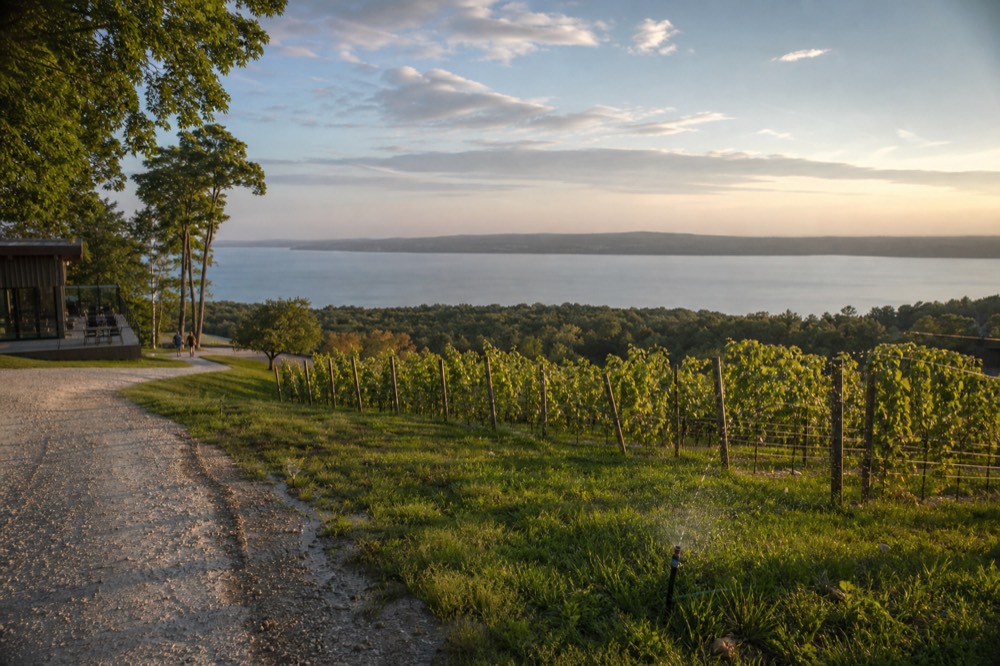
This is why the AVA boundaries stop at the water. The regulation for Old Mission traces the line 19 miles up the western shoreline to the lighthouse near Old Mission Point; there is no ambiguity about where the peninsula ends. The distinctive climate being protected is a shoreline climate. The same federal petitions that established the AVAs would have had no basis for extending them inland, because the distinguishing features weaken exactly there.
| Factor | On the peninsulas | Inland at the same latitude |
|---|---|---|
| Distance from moderating water | Rarely more than 3 miles | Tens of miles |
| Spring bud break | Slowed by cold water, reducing frost risk | Earlier, exposed to late frosts |
| First killing frost in autumn | Held off by warm water | Weeks sooner |
| Soil | Glacial sand and gravel, free-draining | More variable, often wetter |
| Federal recognition | Two AVAs, 1982 and 1987 | None |
The pattern repeats wherever cool-climate wine succeeds. Niagara, the Finger Lakes, the German river valleys: in each case, water or a steep valley does what latitude alone cannot. Traverse City's version is simply unusually tidy, two narrow fingers of land, one bay, one lake, and a federal paper trail that says the climate inside the lines differs from the climate outside them.
What Grows Here, And Why Riesling Leads?
Riesling is the most-planted wine grape in Michigan, at roughly 670 of the state's 3,375 acres of wine grapes, and it leads for the same reason the vineyards exist at all: it ripens reliably in a short, cool season and keeps its acidity here in a way warmer regions cannot match. Chardonnay, Pinot Gris, Pinot Noir and Cabernet Franc follow it, and roughly 70 percent of Michigan vineyard acreage is now classic European Vitis vinifera.
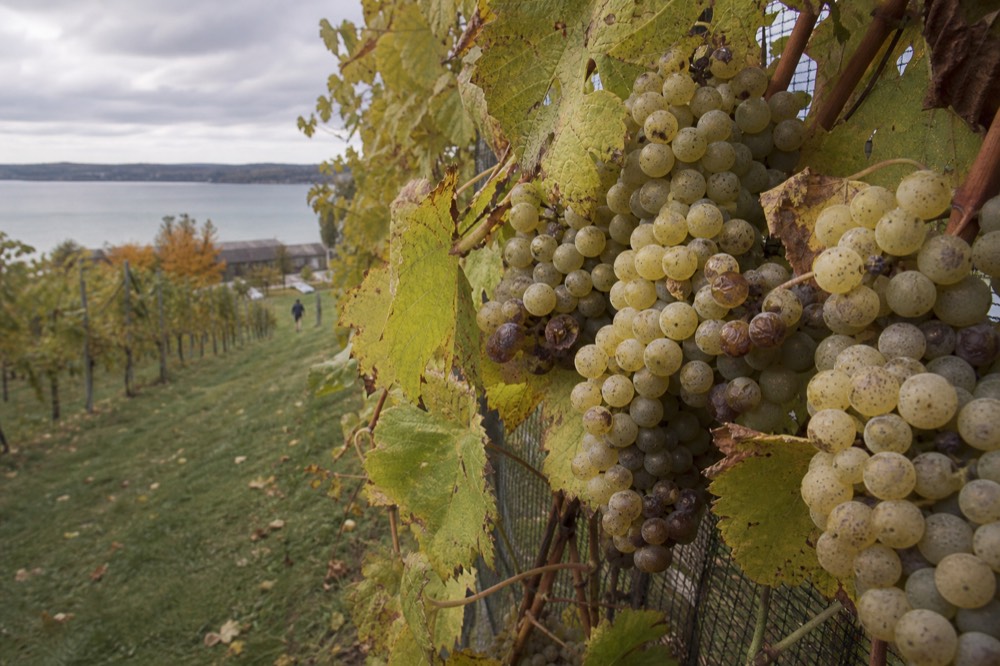
Cool-climate regions do not compete by chasing the big, jammy styles of hotter regions. They compete on freshness, aromatics and acid, and a long, slow ripening season preserves exactly those. A Riesling that ripens over a cool autumn by the bay keeps a spine of acidity that winemakers in warmer zones work hard to avoid losing. That is the practical payoff of the lake effect described above: not just survival, but a style the region can genuinely own.
One honest caveat: no one publishes an acreage breakdown by grape for either of these two AVAs specifically. The 670-acre Riesling figure is statewide. Anyone quoting a precise Riesling or Cabernet Franc acreage "on Old Mission" or "in Leelanau" is inventing it, and this site will not.
The industry behind those vines has grown large enough to measure. The 2025 WineAmerica economic impact study counts 279 wine producers and 13,346 acres of vineyards in Michigan, and puts the industry's total economic activity at $8.96 billion, supporting 52,939 jobs, per the Michigan Wine Collaborative's published summary. Note the measure: that 13,346 acres is total vineyard acreage including juice grapes, not the same thing as the 3,375 acres of wine grapes, and the two figures are not in conflict. Bridge Michigan, reporting on the study, framed it as nearly $9 billion, up 42 percent in three years, even as national drinking rates fall, which tells you the growth is coming from tourism and experiences as much as from bottles.
How Big Is The Region's Wine Industry Now?
The Traverse Wine Coast's two AVAs produce over 60 percent of Michigan's grapes, on a statewide base of 3,375 acres of wine grapes and 775 family-owned farms, and the trails themselves list ten wineries on Old Mission and over 20 on Leelanau. National press has noticed: Travel + Leisure branded the two peninsulas the "Traverse Wine Coast" in November 2025, calling it the "Napa of the Midwest" and citing over 40 wineries.
That "over 40" figure deserves unpacking, because it is where most pages go wrong. Add the two trails' counts and you get roughly 30 to 35, not 40-plus, and one winery, Black Star Farms, appears on both trails, since it operates in Leelanau and pours on Old Mission, so naive addition double-counts it. The higher totals come from counting every licensed producer and tasting room rather than trail membership. All of the counts are defensible; they are just measuring different things. The honest answer to "how many wineries are near Traverse City" starts with the trails' own numbers and explains the disagreement, which is exactly what our count of wineries near Traverse City does in detail.
The growth is not just agricultural. Competition results now put the region's wines on national scoreboards: at the 2026 Taste Michigan Governor's Cup, French Valley Vineyard on Leelanau took Best of Show with a 2024 Dessert Riesling, and Leelanau producers swept several gold categories. The details are in our piece on the best wine in Michigan.
For visitors, the practical shape of the region is simple: one town, two peninsulas, and a couple dozen tasting rooms within a 40-minute drive. The question of which peninsula suits you is covered in our Old Mission versus Leelanau comparison, and the map of how it all lays out is in our Traverse City wine country map.
The older AVA is the one most first-time visitors underestimate. Leelanau's trail is more than twice the size of Old Mission's, and a five-hour loop through three of its estates is a good way to understand why the federal line was drawn there first, five years before its neighbor.
Does The Same Geography Explain The Tasting Room Boom?
Partly. The vineyards exist because of the climate, but the tasting rooms exist because the peninsulas put dozens of wineries within a short drive of a genuine small city, which is rare in American wine country. Traverse City itself was named Food City of the Year in Midwest Living's Best of the Midwest Awards for 2026, and annual tourism spending across the four-county region passed $1.14 billion, per figures Traverse City Tourism presented at its 2026 annual meeting.
Wine regions usually make you choose: world-class vines and a sleepy town, or a real city an hour from the vines. Here, downtown Traverse City sits at the base of both peninsulas. You can taste at three wineries and still be back for dinner downtown, and the food scene has grown up alongside the wine scene, with chefs earning James Beard semifinalist recognition and the city placing sixth for Best Small Town Food Scene in the USA Today 10Best Readers' Choice Awards for 2026.
That combination is what turns a vineyard region into a touring region. It is also why the tour market here splits into two formats, a shared shuttle bus on scheduled routes and small semi-private SUVs, both of which can legally pour on board because Michigan's open-container statute exempts passengers in chartered vehicles authorized by the state transportation department. The law and the geography work together: narrow peninsulas with one spine road each, M-37 up Old Mission, make a guided loop genuinely sensible rather than merely convenient. This whole touring ecosystem, from the AVA boundaries to the shuttle routes, is what Traverse City Wine Tours exists to help you navigate.
One structural note worth knowing: the Old Mission wineries spent five years in federal litigation with Peninsula Township over zoning rules limiting events and on-site sales, winning a judgment of roughly $50 million in July 2025. As of September 2026 the case is on appeal and collection is stayed, so treat it as unresolved rather than settled. It matters to visitors mainly as evidence that the tension between agriculture and tourism on these narrow peninsulas is real and ongoing.
Can You See The Vineyard Geography For Yourself In A Day?
Yes, easily, and it is the best way to make the lake-effect argument concrete. Old Mission can be driven end to end in under an hour, with the lighthouse at the tip, and Leelanau's loops take a half-day. A guided tour handles the driving on the single spine roads, and the shared shuttle options run from $74 to $79 per person while the semi-private SUV tours start at $69 per person with samples included.
The fee structure differs by operator, and it is the sharpest practical distinction in this market. The Magic Shuttle Bus tours are transport only, with tasting fees of roughly $5 to $10 per stop paid at the bar on Old Mission. Movie Stars Wine Tours includes samples plus a complimentary bottle, with flights and food extra. Our full breakdown lives in the Traverse City wine tour prices guide.
Whichever way you go, the drive itself is the argument. Watch how the rows sit on ridges that slope toward the water on both sides, how the vines stop where the shoreline climate stops, and how the whole arrangement repeats on the next peninsula across the bay. That is the answer to the question, visible from the window of a shuttle.
The Old Mission loop makes the narrowness of the peninsula unmistakable, water on the left, water on the right, vines in between, and the four-wineries-in-five-hours shared run is the most popular way to see it.
If you would rather compare all three formats side by side before choosing, the shortlist below gathers the Leelanau loop, the Old Mission shuttle and the semi-private SUV alternative in one place.
Traverse City's vineyard density comes down to the 45th parallel, two narrow peninsulas surrounded by moderating water, glacial soils, and federal recognition of the resulting climate in 1982 and 1987. The questions below cover the specifics visitors ask most, from the AVA dates to the lake effect itself, with every figure drawn from the trails, the regulations and the statewide industry data.
Common Questions About Traverse City Vineyards
Why Does Traverse City Have So Many Vineyards?
Because its geography is unusually favorable for cool-climate grapes: the city sits on the 45th parallel, its two narrow peninsulas are never far from the moderating water of Grand Traverse Bay and Lake Michigan, and glacial soils drain well. The federal government recognized the distinct climate by establishing the Leelanau Peninsula AVA in 1982 and the Old Mission Peninsula AVA in 1987.
What is the 45th parallel and why does it matter for wine?
It is the circle of latitude halfway between the equator and the North Pole, and it runs through Traverse City, as well as through parts of Bordeaux's latitude neighbors and Piedmont. Latitude alone does not make a wine region, but it sets the day length and season length, and the lake effect supplies the moderation that lets grapes ripen at this northerly line.
Which AVA is older, Leelanau or Old Mission?
Leelanau, by five years. The Leelanau Peninsula AVA was established on March 30, 1982, under 27 CFR 9.40. The Old Mission Peninsula AVA followed on June 8, 1987, under 27 CFR 9.114.
How many wineries are on each peninsula?
The trails' own numbers are ten wineries on the Old Mission Peninsula Wine Trail and over 20 on the Leelanau Peninsula Wine Trail. Third-party counts run higher because they count every licensed producer or tasting room rather than trail membership, and Black Star Farms appears on both trails, so adding the two lists double-counts it.
What grape is most planted around Traverse City?
Riesling is the most-planted wine grape in Michigan at roughly 670 acres statewide. No official acreage breakdown by grape exists for either AVA individually, so any per-peninsula figure you see is an estimate rather than a sourced number.
Does the lake effect really prevent frost?
It does not prevent frost; it shifts the timing. Cold water delays bud break in spring, reducing the risk of a late frost killing new buds, and warm water in autumn delays the first killing frost. The effect fades within miles of the shore, which is exactly why the vineyards cluster on the peninsulas rather than inland.